Blog·9 min read
What to check before buying a property in Spain: a property expert’s checklist
What you can spot on the first viewing, what only a surveyor will find, and the paperwork to have in hand before you sign the deposit contract.
By Valeria Reggi · Licensed estate agent (API) and court-appointed property expert
Published on ·Updated November 2026
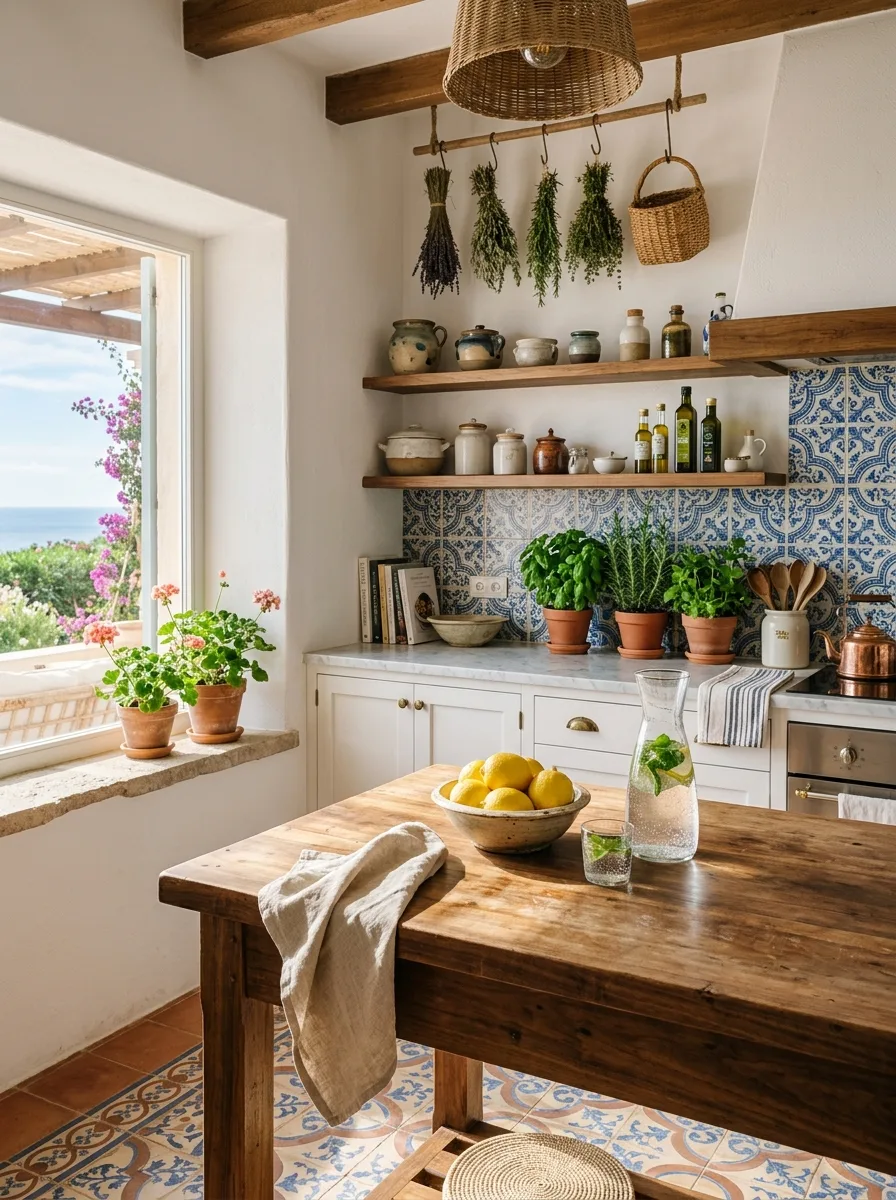
It was a house renovated "as new": freshly painted walls, spotless floors, a magazine-worthy kitchen. The buyer signed convinced she had avoided any surprises. A few months later, a stain began to spread along the bottom of the walls, the plaster bubbled and the paint started to peel. It was rising damp: groundwater climbing up through the walls, the way coffee soaks up a sugar cube.
The seller said he knew nothing about it. Perhaps that was true. Fresh paint hides the symptoms for a while, which is why a newly renovated home can hide more than one shown exactly as it is.
I have been working on this same stretch of coast for more than six years, and some problems come up again and again. Living by the sea is a gift, but it comes with small print: damp rising from the ground, wooden beams nobody checked, a septic tank nobody mentioned. Almost all of it can be spotted before you sign, if you know where to look. That is why good advice from the very start matters: it saves you headaches and costs nobody had planned for.
As a court-appointed property expert (perito judicial inmobiliario), part of my work begins once a problem already exists. This article is about the opposite: what to check beforehand, while you can still negotiate, ask for a report or walk away. I have organised it in four steps, from what you can see for yourself to what only shows up in the paperwork.
Step 1. The first viewing: what you can see for yourself
You do not need to be a surveyor on the first viewing, but you do need to look carefully and with purpose. Take your phone torch, go in daylight and, if you can, come back on a rainy day.
Damp (very important). Look at the bottom of the walls, especially in ground-floor homes and houses close to the sea. There are three types worth telling apart:
- Rising damp: it comes up from the ground. It is more common near the sea, where the water table tends to be higher. Look for stains in the first metre of wall, swollen skirting boards and white salt deposits.
- Penetrating damp: it gets in from outside, through the roof, façade or terrace. Look for stains on ceilings and in high corners.
- Condensation: it forms inside, through poor ventilation. Look for black mould in cold corners and around window frames.
Cracks. A fine hairline crack in the plaster is usually cosmetic. Diagonal cracks, cracks running from the corners of doors and windows, or cracks repeated in the same spot on several floors should be looked at by a professional.
Signs that something has been covered up (look closely).
- Fresh paint on just one wall, or only on the lower part of it.
- A damp smell masked with air freshener, or a dehumidifier running.
- Large furniture pushed up against one particular wall.
- Doors and windows that stick or will not close: they can be a sign of movement.
Everything else to look at. The condition of windows and shutters, water pressure (turn on two taps at once), the fuse box (if it looks old, note it for the surveyor), orientation and natural light, and street noise at different times of day.
The septic tank: always ask. A septic tank is an underground tank that collects the house’s waste water where there is no mains sewer. I come across them often on residential estates (urbanizaciones), and it is one of the things nobody mentions during a viewing.
- If the estate has no mains sewer, a septic tank is normal. Ask when it was last emptied and which company does it: it is a recurring cost you will take on.
- If the estate does have a mains sewer, the house should be connected to it and the septic tank decommissioned. Ask whether it is, and ask for proof. Removing the tank altogether is the most hygienic option.
- The warning sign is the smell: in the garden, near the entrance or around the drains.
More than one buyer has discovered after moving in that the house was not connected to the sewer, even though the street was.
Step 2. The second viewing: bring a surveyor
If you are serious about the house, do not do the second viewing on your own. Go with an architect or a building surveyor you trust. What a professional picks up cannot be seen with the naked eye, and their report costs far less than any of the problems it can save you from.
Structure. Floor slabs, beams, columns and foundations. The surveyor reads the cracks you noticed on the first viewing and tells you whether they are cosmetic or structural.
Wooden beams and woodworm. On a chair you can see the little holes. On a ceiling beam covered with paint or plaster, you cannot. If the house has wooden beams, exposed or hidden, ask the surveyor for a specific assessment.
Tip
Ask for the timber assessment in writing, signed by the surveyor. That document protects you if damage appears later, and it gives you leverage to negotiate the price if repairs are needed.
Services. Electrics, plumbing and gas are among the most expensive things to redo. The surveyor checks the fuse box, the earthing, the pipes (lead or iron in older houses) and the boiler.
Buying a flat: the building inspection (ITE). In Catalonia, every residential building must undergo a technical inspection before it turns 45, under Decree 67/2015. The responsibility lies with the community of owners. The result is the Informe d’Inspecció Tècnica de l’Edifici (IITE), and if it finds serious defects the community will have to carry out works. That is why it is worth asking for it before buying a flat in an older building: it tells you what works are coming and, possibly, what special levies.
For a detached house with a valid habitability certificate, the report is not compulsory until that certificate expires (Generalitat de Catalunya, building inspection FAQ).
Step 3. The paperwork: before you sign the deposit contract
In Spain, the deposit contract (contrato de arras) is the agreement with which you reserve the property by paying a deposit. If you pull out afterwards, you normally lose that money. That is why the paperwork is checked before, not after.
1. The land registry extract (nota simple): who owns it and what is owed on it. It is a summary from the Land Registry with the description of the property, its owners and any charges: mortgages, court seizures, usufructs and restrictions. You can order it online from the Spanish Association of Land Registrars and it usually arrives within hours, with an English translation available on request (Registradores). The property must reach the notary free of charges, or with their cancellation arranged at the signing itself.
2. Is it officially protected housing? In Catalonia this is called HPO (habitatge amb protecció oficial), known elsewhere in Spain as VPO. Protected housing has a maximum sale price set by the regional government, and the Catalan Housing Agency must approve the sale to check that price is not exceeded. It must also be used as the owner’s main home. If the seller received purchase grants in the last 10 years, they need authorisation to sell (Generalitat de Catalunya, HPO; resale prices).
In practice
I have seen protected-housing status come to light after a deposit contract was signed. When it surfaces late, the agreed price may exceed the legal maximum and the sale gets complicated. Check the land registry extract and, if in any doubt, the Catalan Housing Agency, before paying any deposit.
3. Habitability certificate (cédula de habitabilidad). In Catalonia it is compulsory to sell a home, including resales. For existing homes it is valid for 15 years (Decree 141/2012). If it has expired, the seller must renew it, which can delay completion by a few weeks.
4. Energy performance certificate. The seller must attach a copy of the registered certificate and its label to the contract, and the energy rating must already appear in the listing (Royal Decree 390/2021, art. 17).
In practice
Without the habitability certificate and the energy certificate there is no signing at the notary, and getting them usually takes about two weeks. A good agent has them ready from day one.
5. Making sure the square metres add up. A property’s floor area appears in four places that do not always match: the title deed (and the land registry extract, which is based on it), the Cadastre, the habitability certificate and the bank’s valuation.
- What the law says: the Spanish Mortgage Act allows small discrepancies in floor area to be corrected without a full procedure (art. 201.3). Larger ones require a longer process (Mortgage Act, BOE). Whether a discrepancy counts as small is assessed by the notary and the registrar case by case.
- What we see in practice: if the buyer needs a mortgage, the bank’s valuer compares the habitability certificate, the Cadastre and the land registry extract, and flags any mismatch. A small difference, such as an enclosed balcony, usually goes through. A large one means calling in a surveyor to measure. The real problem is anything built without being declared: an extension or a basement that was never registered.
A real case: a house with a basement opened up 20 years earlier with planning permission, but never recorded at the Land Registry. It could be fixed, but it takes time: a surveyor’s certificate and a declaration of new building work. Ideally, the owner should regularise it before putting the house on the market.
6. Community fees and special levies. In Catalonia, the property is liable for community fees for the current year and the four previous years, even if the debt is the seller’s. That is why the seller must provide a certificate from the community secretary; without it the deed cannot be signed unless both parties expressly waive it. The certificate also lists special levies already approved and still to be paid (Catalan Civil Code, art. 553-5). My advice: do not waive the certificate and, if a levy shows up, use it to negotiate.
7. IBI (local property tax). This is the annual municipal tax on the property. If the seller leaves bills unpaid, the property remains liable for that debt even after it changes hands, and the town hall can claim it from the new owner on a secondary basis. The notary must warn you about this at the signing (Local Finance Act, art. 64). Ask for the latest paid IBI receipt before you sign.
Step 4. The location: by the sea, with its own rules
The same house is worth, and "works", differently depending on where it is. On the coast between Sitges and Calafell there are three things worth knowing before you buy.
The Coastal Law (Ley de Costas). Along the sea there is a protection zone that runs 100 metres inland as a general rule, and 20 metres on land that was already urban in 1988. No new homes can be built within it. Existing ones can stay and be repaired or modernised, as long as their volume, height and floor area do not increase, with authorisation or a formal declaration depending on the case (Law 22/1988, arts. 23 and 25; Ministry FAQ). If you plan to extend a house near the beach, check this before you buy.
In practice
In ground-floor homes near the sea, damp is more common, and so are extensions built without permission. They are the two things I look at most closely.
Rent-controlled areas. Sitges, Vilanova i la Geltrú and Cubelles on the one hand, and Calafell and Cunit on the other, were declared stressed residential market areas (zonas de mercado residencial tensionado) by the Catalan government in 2024. This means rents on long-term residential lets are capped. In October 2026 the Generalitat extended the declaration for one year in 118 municipalities and added 53 new ones (Resolutions TER/3739/2026 and TER/3740/2026). Check your town on the official list and, if you are buying to let, work out your yield with that cap, not with what the market is asking.
Holiday lets. Buying and listing is not enough. In the municipalities listed in the annex to Decree-Law 3/2023, a holiday rental needs prior planning permission from the town hall, valid for five years, with a ceiling of 10 licences per 100 inhabitants (Generalitat de Catalunya, Canal Empresa). Before buying with that plan, ask the town hall whether the property can obtain a licence: each council may have suspended or restricted new ones.
Buying well means buying with your eyes open
Buying well is not about finding the perfect house. It is about knowing exactly what you are buying, what you will have to fix and what it is really worth, before you sign anything. Fresh paint, time pressure and an attractive price are exactly what make people skip these steps.
Thinking of buying between Sitges and Calafell?
Let’s review the property together before you sign. A timely conversation can save you months of problems.